Income by Design
A modern framework for retirement confidence
Retirement isn’t just about how much you've saved, it’s about how confidently you can spend. Income by Design examines the shift from account balances to income strategies that support certainty, flexibility, and long-term confidence.

The retirement equation is no longer just about saving — it’s about creating retirement certainty that delivers lifetime income and supports sustainable retirement spending.
Guardian Wealth Advanced Markets’ latest publication explores how to balance growth and guaranteed sources to stay protected, invested, and confident in a more complex environment.

Guardian’s Erin Culek and BlackRock’s Nick Nefouse discuss how shifting from a focus on account balances to whole‑portfolio retirement planning can support smarter retirement spending and more dependable lifetime income.
Client spotlight
Retirement designed around life
David and Terry Katz worked with Gary Sirak and Jeff Sirak to create a bespoke plan that shifted from simple accumulation to a retirement strategy built around income, protection, and flexibility that aligned their plan with the life they want to live.


Strategic frameworks for retirement planning
An in-depth look at how retirees can build an income strategy that covers essential expenses while allowing for growth, tax efficiency, and changing priorities, and how a solid lifetime income foundation can help ensure more predictable spending throughout retirement.
Erin Culek
Head of Financial Protection and Retirement Solutions, Guardian
Erin is responsible for driving profitable growth in Guardian’s individual life, annuity, and disability businesses.
Nick Nefouse
Global Head of Retirement Solutions and Head of LifePath, BlackRock
Nick leads research and product strategy focused on retirement, including LifePath, BlackRock’s global target date fund franchise.
- Clients
David and Terry Katz
Background: David is a retired pediatrician and former practice owner; Terry spent her career in the nonprofit sector.
Planning priorities: Creating dependable retirement income, reducing financial stress, creating generational wealth, and aligning their finances with the life they want to live in retirement.
Long-term goals: Planning for longevity while also protecting legacy and supporting future generations, including college savings for their grandchildren.
- Advisors
Gary Sirak and Jeff Sirak
Relationship: Working with David and Terry Katz since 2001.
Approach: Holistic planning that starts with the whole person — values, goals, and vision for life after work.
Strategy focus: Integrating protection, annuity-based retirement income, growth, and legacy planning with whole life insurance to support confidence, flexibility, and long-term sustainability.
Team: The Sirak Financial team, including Lisa Fleming, Raquel Thompson, Tara Gordan, and Nikki Baldwin, help deliver a great experience
“We sleep well at night knowing our retirement income will last our whole lives — and that the planning we’ve done will take care of our family when we’re gone.”
David and Terry Katz
“Our planning starts with the life our clients want to live in retirement — not the money. Once you understand that, the financial strategy becomes a way to support that life, not the other way around.”
Gary Sirak
Can you provide a comprehensive, 30,000-foot view of my plan — showing how everything fits together today, five years from now, and 10 years from now?
How does my plan account for longevity and the risk of running out of money?
How do income strategies, investments, and protection work together as part of one coordinated plan?
How are fees structured across different strategies, and how will I understand what I’m paying for?
How often will we meet, and how easy is it to reach you — and your broader team — when questions come up?
Retirement income, taxes, and essential expenses:
Incorporating flexibility and guarantees to promote efficiency
Jim Magner
Retirement income looks different today
One of the most consequential decisions facing individuals and families today is determining how much income is needed in retirement — and whether enough assets are available to meet that need through a well‑structured retirement income strategy. Longer lifespans, increased market volatility, and the decline of traditional pensions mean that sufficient income is no longer automatically delivered, it must be intentionally designed to support sustainable retirement spending and long‑term financial security.
For high‑net‑worth individuals and business owners, this challenge is magnified by uneven cash flows, concentrated equity exposure, and tax complexity following a liquidity event such as the sale of a business, all of which have direct implications for creating reliable lifetime income.
Start with clarity: What needs to be funded — and how flexible is it?
An effective retirement income strategy begins with clarity around spending. Not all expenses carry the same importance or tolerance for risk, and distinguishing between them provides the foundation for informed decisions later on. To adequately plan, you must assess:
Essential expenses that must be met regardless of markets.
Lifestyle expenses that can adjust over time as part of flexible retirement spending.
Irregular or one‑time expenses that require liquidity and planning.
The anchor strategy: Build an income floor so the portfolio can do its job
An income floor represents the portion of retirement income designed to support essential expenses with a high degree of reliability to reduce dependence on portfolio withdrawals during volatile periods or when the market is down, a key factor in stabilizing long‑term retirement spending. The income floor separates an investor’s financial security from market uncertainty, and it can be created in different ways, including pensions, cash or bond ladders, and other predictable income sources. The appropriate structure depends on an investor’s goals, risk tolerance, tax profile, and liquidity needs, but the goal remains clear: create enough guaranteed income so the rest of the strategy can be built with greater flexibility.
Many consider Social Security first when thinking of guaranteed income. But, for affluent retirees, Social Security often represents a relatively small portion of total income and must be heavily supplemented. However, benefit timing can materially influence taxation by interacting with earned income, portfolio withdrawals, and provisional income rules. As a result, Social Security planning for wealthy households is less about income replacement and more about tax coordination within a broader retirement income strategy.
Key tax considerations when entering your 60s
The 3.8% net investment income tax (NIIT): A 3.8% tax that applies to investment income, once modified adjusted gross income exceeds applicable thresholds.
Capital gain taxes: Long-term capital gains, while taxed at lower rates than ordinary income, can push you into a higher effective tax bracket if poorly timed.
Social Security taxation: Up to 85% of your SSI benefits can become taxable if your provisional income exceeds certain thresholds. Withdrawals from IRAs, realized capital gains, and even tax-exempt interest can increase provisional income, reducing the after-tax value of benefits.
Because each additional dollar of income can affect multiple tax calculations simultaneously, retirement income sources do not operate independently. Coordinated income planning seeks to manage taxes thoughtfully across retirement rather than minimizing them in any single year.
Single premium immediate annuities (SPIAs) are another vehicle for creating guaranteed income. When funded with after‑tax assets, a portion of each payment is typically treated as a return of principal, which can help limit the incremental taxable income created. By covering a portion of essential expenses, income from a SPIA can reduce the need to sell investments or take larger IRA withdrawals during tax‑sensitive years, supporting more stable retirement spending in varying market environments.
It is important to note that this approach can be very flexible and does not have to be all or nothing. The structure and duration of guaranteed income can be matched to the specific income need, helping retirees create a personalized lifetime income foundation.
The structure of an income floor should reflect how an individual transitions into retirement, supporting the shift from accumulation to retirement spending in a balanced and sustainable way:
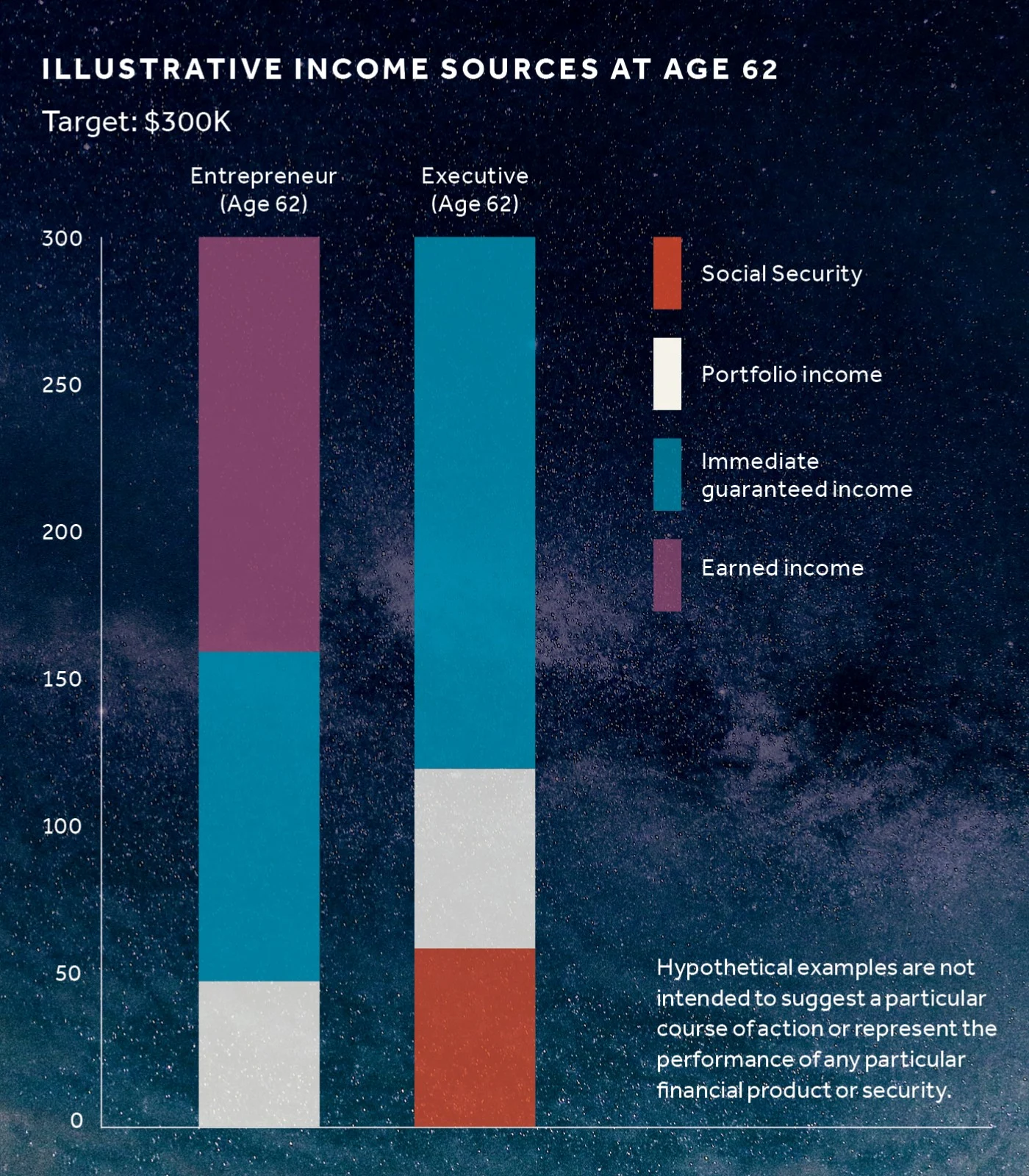
For an entrepreneur who continues to earn income after selling a business, guaranteed income may be used for a defined period, helping bridge income needs until earned income declines further or Social Security can be claimed without temporary benefit reductions that apply when income exceeds certain thresholds before full retirement age.
For others, such as a retiring executive who fully exits their profession, guaranteed income may be designed to last for life, replacing a paycheck immediately and providing long‑term stability.
In both cases, guaranteed lifetime income is not a tax‑free solution, but it can improve coordination by allowing other assets to be taxed more intentionally over time.
Retirement income inventory
Guaranteed income is one of several tools that may be used to create your income floor for essential expenses. Once that foundation is established, the next step is understanding how all remaining income sources fit together — while considering liquidity needs, tax situation, and long-term objectives that support sustainable retirement spending and reliable lifetime income.
A useful starting point is to inventory expected sources of retirement income using the checklist below as a starting point. For affluent households, income often comes from multiple sources with differing levels of predictability, flexibility, and tax treatment. The objective is not to rely on any single source, but to understand how they may work together over time to support a coordinated retirement income strategy that adapts to changing needs.
More predictable / Stable | More flexible / Variable |
|---|---|
Guaranteed income (pension or SPIA) | Earned or consulting income |
Social Security | Portfolio withdrawals |
Other predictable income sources | Portfolio income (dividends and interest) |
| no | Trust distributions |
| no | Cash value life insurance access |
Designing retirement income over time: A laddered approach
For many high‑net‑worth individuals and business owners, guaranteed income can be most effective when structured in layers — aligned to how earned income changes, when Social Security begins, and how tax considerations evolve over time. A laddered approach allows retirees to add reliability intentionally, where it supports the plan most.
Example: Entrepreneurial business owner
Earned income often continues, but at a reduced and uneven level.
A smaller layer of immediate guaranteed income can help bridge the gap between lower earnings and essential spending.
Later layers may begin as earned income declines further, shifting focus to longevity protection.
Example: Retiring executive
Earned income ends at retirement, creating an immediate income gap.
An initial layer of guaranteed income can begin right away to cover essential expenses.
Additional income can be added later to protect against longevity and health care costs.
Retirement income roadmap
Confirm essential expenses and target income stability.
Coordinate Social Security and earned income expectations.
Determine the timing and scale of guaranteed income additions.
Use the early retirement years intentionally.
Review the strategy annually (or after major life or tax changes) to reassess spending, tax brackets, Social Security timing, and withdrawal sequencing.
Why sequencing matters
The illustration highlights how income design can differ meaningfully even when goals are the same. A retiring professional who fully exits their career may rely more heavily on immediate guaranteed income to replace a paycheck and support essential expenses. By contrast, an entrepreneur who continues to earn income — often unevenly — may use a smaller initial layer of guaranteed income to supplement cash flow and support more flexible retirement spending, deferring other sources until later.
For many affluent individuals, the years between a liquidity event — such as the sale of a business — and required minimum distributions (currently age 73 for IRAs) represent a particularly important planning window structuring lifetime income. Income during this period is often lower and more controllable, creating opportunities to coordinate taxes deliberately through strategies such as Roth conversions, capital‑gain management, and intentional withdrawal planning.
By covering a portion of essential expenses with guaranteed income during these years, retirees may reduce the need to sell investments or take larger tax‑deferred withdrawals. When funded with after‑tax assets, a portion of each payment is typically treated as a return of principal, which can help limit incremental taxable income.
These examples are intended to make one point clear: Guaranteed income can be integrated into a retirement income strategy to solve specific needs — near‑term stability, a bridge to Social Security, or long‑term longevity protection supporting lifetime income — rather than treated as a single, permanent decision. Any approach that increases income predictability may involve trade-offs, including reduced liquidity and opportunity cost, so practical designs typically preserve readily accessible reserves for unexpected needs and changing priorities.
Guaranteed income and investments
Once reliable income is in place, the role of the remaining investment portfolio can change in meaningful ways. Rather than being designed primarily to generate cash flow, these assets may be positioned with greater flexibility around growth, risk management, and long-term objectives.
When portfolios are relied upon to fund day-to-day spending, investment decisions are often constrained by income needs. This can result in an emphasis on yield-oriented strategies, forced sales during market downturn, or a reluctance to tolerate short-term volatility. By contrast, when essential expenses are supported by predictable income sources as part of a structured retirement income strategy, the investment portfolio may no longer need to serve as the primary vehicle for retirement spending.
This shift can create several planning advantages.
Greater alignment with the investor’s risk profile: With income needs addressed elsewhere, investment strategy can be more closely aligned with the investor’s true risk tolerance, time horizon, and long-term goals.
Reduced pressure to generate yield: When portfolios are not required to produce consistent income, there may be less emphasis on yield alone, allowing for broader diversification across asset classes and incorporating those that may offer lower current income but greater long-term growth potential.
Improved tax coordination: Separating income stability from investment growth can also improve tax coordination. Portfolio withdrawals, capital gains realization, and tax-efficient asset placement can be managed more intentionally when they are not dictated by spending needs.
Flexibility as priorities evolve: Retirement is not static. Structuring income and investments separately can provide flexibility to adapt as circumstances evolve, by adjusting investment risk, changing withdrawal strategies, or reallocating assets.
Ultimately, this approach is not about maximizing returns or minimizing risk in isolation. It is about creating a structure in which reliable income supports essential needs, while investments are positioned in a way that reflects the investor’s broader financial picture.
Confidence comes from coordination
In a retirement landscape shaped by uncertainty, the most effective retirement income strategies combine structure with flexibility to support lifetime income and long‑term retirement spending needs. Reliable income is not about eliminating risk, it is about creating space for better decisions across investments, taxes, and lifestyle. When income sources are aligned thoughtfully through a coordinated retirement income strategy, wealthy individuals gain greater clarity, control, and confidence in the years ahead.
Why is retirement planning shifting from account balances to income?
Retirement planning is increasingly focused on income because people are living longer, facing more market ups and downs, and relying less on traditional pensions. Simply building a big nest egg isn’t enough anymore — what matters is how reliably your savings can generate income that lasts in retirement, which is the core goal of any retirement income strategy.
What is whole-portfolio retirement planning?
Whole-portfolio retirement planning is an outcomes-based retirement income strategy that integrates income, protection, investments, and taxes into one system. It begins with the desired outcome — not the product — and reshapes risk so people can focus on long-term durability rather than short-term volatility. By viewing insurance, investments, and fixed income as complementary tools rather than standalone solutions, this approach shifts the focus from the size of one’s wealth to how effectively it can generate reliable income over time.
What is an income floor, and why does it matter in retirement?
An income floor is the part of your retirement income strategy designed to reliably cover essential expenses, helping you avoid withdrawing from investments during market downturns. By using predictable sources — such as pensions, annuities, cash or bond ladders, and other guaranteed income tools — you can create a lifetime income foundation tailored to your goals, risk tolerance, tax profile, and liquidity needs. With this stable base in place, the rest of your portfolio can be invested more flexibly to support long‑term growth while still accommodating taxes, liquidity, and evolving priorities.
Why do many retirees spend less than they can afford?
When markets fall, retirees often reduce retirement spending out of fear even when their long‑term outlook hasn’t changed. When a portion of your income is guaranteed, you can naturally feel more comfortable spending with confidence.
How should a retirement income strategy adapt over time?
A strong retirement income strategy should evolve as your life does. Separating income sources from investments gives you flexibility to adjust retirement spending, investment risk, and withdrawal methods over time. Annual check‑ins help you reassess taxes, account withdrawals, Social Security timing, and alignment with long‑term objectives — ensuring your plan continues to support sustainable lifetime income.
About Guardian Wealth Advanced Markets
A team with over 255 cumulative years’ experience in advanced planning for individuals, businesses, and wealth transfer, Guardian Wealth Advanced Markets serves as an in-house expert to Guardian’s financial advisors. They provide real-time insights, counsel, commentary, and resources that enable our financial advisors to support every facet of clients’ financial lives, from business, family, legacy, and protection to liquidity and retirement.
Download the report
Guardian Wealth Advanced Markets (“GWAM”) provides support to financial advisors in connection with complex planning strategies, including but not limited to estate planning concepts, tax-efficient investment strategies, insurance-based planning, business succession considerations, and wealth transfer techniques. GWAM professionals act in an educational capacity only and do not provide any legal, tax, investment advice, or brokerage services. The views presented in this publication are not intended as a specific recommendation or solicitation of any security, strategy, product, or service. Views expressed reflect current conditions as of publication and may change without notice. Past performance is not a guarantee of future results. This material is intended for general public use. By providing this content, The Guardian Life Insurance Company of America, and their affiliates and subsidiaries are not undertaking to provide advice or recommendations for any specific individual or situation, or to otherwise act in a fiduciary capacity. Please contact a financial representative for guidance and information that is specific to your individual situation.
Guardian Wealth Advanced Markets is not a registered investment adviser, broker-dealer, or separate legal entity. Guardian Wealth Advanced Markets is a division of The Guardian Life Insurance Company of America (“Guardian”) that provides consultative services for Guardian and its affiliates The Guardian Insurance & Annuity Company, Inc., and Berkshire Life Insurance Company of America. Guardian and their insurance-affiliated entities are licensed to do business in all 50 states. Not all products and services are available in all states. Securities products and investment advisory services are provided by Park Avenue Securities LLC, a FINRA-registered broker-dealer and SEC-registered investment adviser, and Park Avenue Investment Advisory, LLC, an SEC-registered investment adviser. All accounts and services are subject to the terms and conditions of the respective underlying entities. The terms “planning”, “financial planner”, “financial advisor”, or “advisor” are used generically and are not references to providing investment planning or advisory services in each instance. Only planners or advisors who hold the requisite investment advisory registration can provide investment advisory planning services.
This material does not constitute a recommendation by BlackRock, Inc. or its affiliates ("BlackRock"), or an offer to sell, or a solicitation of any offer to buy or sell any securities, product or service, in any jurisdiction to any person. The information is not intended to provide investment advice. BlackRock does not guarantee the suitability or potential value of any particular investment. This is not intended for distribution to, or use by, any person or entity in any jurisdiction or country where such distribution would be unlawful under securities laws of such jurisdiction.
Park Avenue Securities, LLC (PAS) is a wholly owned subsidiary of The Guardian Life Insurance Company of America .
Park Avenue Investment Advisory, LLC., (PAA) is an indirect, wholly owned subsidiary of The Guardian Life Insurance Company of America. PAS and PAA are located at 10 Hudson Yards, New York, NY 10001.
Variable annuities and their underlying variable investment options are sold by prospectus only. Investors should consider the investment objectives, risks, charges, and expenses carefully before investing. This and other information are contained in the prospectus or summary prospectus, if available, which may be obtained from your investment professional. Please read it before you invest or send money.
The primary feature of whole life insurance is the death benefit. All whole life insurance policy guarantees are subject to the timely payment of all required premiums and the claims-paying ability of the issuing insurance company. Policy loans and withdrawals affect the guarantees by reducing the policy’s death benefit and cash values.
Annuity guarantees are backed exclusively by the strength and claims-paying ability of the issuing insurance company. BlackRock is not affiliated with Guardian or its subsidiaries. Their opinions are their own and are subject to change without notice.
Not a Deposit | Not FDIC or NCUA Insured | May Lose Value | No Bank or Credit Union Guarantee
All trademarks are the property of The Guardian Life Insurance Company of America. © Copyright 2026 The Guardian Life Insurance Company of America.
